
The Wheel of the Year: What It Is and How to Celebrate the 8 Sabbats

Updated: Jul 26
The Wheel of the Year is a spiritual calendar that divides the year into eight seasonal festivals known as Sabbats. Four major Sabbats of Celtic origin (Samhain, Imbolc, Beltane, and Lammas) and four minor Sabbats based on the solstices and equinoxes (Yule, Ostara, Litha, and Mabon) mark the rhythm of this annual cycle. Each Sabbat celebrates a unique aspect of nature's energy and offers simple rituals to help you reconnect with the Earth. This complete guide explores the meaning of the Wheel of the Year, the symbolism of each Sabbat, and practical ways to celebrate them in your everyday life.

I still remember my first truly conscious Samhain. I had placed a photograph of my father on a small table, lit a black candle, and simply sat in the silence of the evening. At the time, I didn't know that what I was experiencing had a name. I only knew that, on that autumn night, something inside me longed to honor what was ending so that something new could begin.
As I explored that feeling more deeply, I discovered the Wheel of the Year—a cycle of eight seasonal festivals that has guided the rhythm of nature for centuries. The more I incorporated it into my own spiritual practice, the more I realized how much we lose when we disconnect from the natural cycles of the Earth.
If you've been longing to reconnect with those rhythms, this guide will walk you through everything you need to know. You'll discover where the Wheel of the Year comes from, what each Sabbat represents, and how to celebrate them with simple, meaningful rituals—no elaborate tools or specific beliefs required.
What Is the Wheel of the Year? Origins and Meaning
The Wheel of the Year is a symbolic calendar that represents the annual cycle of the seasons through eight festivals known as Sabbats. Instead of viewing time as a straight line, it invites us to experience it as a repeating spiral, where every ending naturally gives birth to a new beginning.
From Ancient Celtic Festivals to the Modern Wiccan Wheel of the Year
The roots of the Wheel of the Year can be traced back to the agricultural societies of pre-Christian Europe, particularly among Celtic and Germanic peoples. Their lives revolved around the changing seasons, the planting and harvesting cycles, and the ever-shifting balance between light and darkness. These celebrations were not merely practical—they were sacred moments of connection with the living forces of nature.
During the twentieth century, the modern Wiccan movement brought these seasonal festivals together into the eight-part cycle now commonly known as the Wiccan Wheel of the Year. While the structure itself is relatively modern, it draws inspiration from genuine historical traditions.
For me, historical precision isn't the most important part. What matters is the timeless wisdom these festivals continue to offer: learning to move with the rhythms of the Earth instead of living disconnected from them.
Major and Minor Sabbats: What's the Difference?
The eight Sabbats are divided into two groups.
Major Sabbats have Celtic origins:
Samhain
Imbolc
Beltane
Lammas (also known as Lughnasadh)
These festivals mark important stages of both the agricultural year and our own inner transformation.
Minor Sabbats are based on astronomical events:
Yule
Ostara
Litha
Mabon
They correspond to the two solstices and the two equinoxes, moments of balance or transition in the Earth's yearly cycle.
Together, these eight festivals create a harmonious cycle, with each Sabbat naturally preparing us for the next approximately every six to seven weeks.
The 8 Sabbats of the Wheel of the Year and Their Rituals
Below are the eight Sabbats of the Wheel of the Year, following the seasonal calendar of the Northern Hemisphere. If you live in the Southern Hemisphere, simply reverse the dates by six months. What matters most is honoring the season you are actually experiencing—not the calendar itself.
1. Samhain (October 31) — The Witches' New Year
Samhain marks the end of the harvest season and the symbolic beginning of the Wiccan year. Often considered the most sacred Sabbat, it is associated with the thinning of the veil between the physical and spiritual worlds.
This is a time to honor your ancestors, reflect on the year that has passed, and embrace the growing darkness as a season of introspection rather than something to fear.
Simple ritual: Light a black or orange candle, place a photograph of a loved one who has passed away nearby, and spend a few quiet moments speaking to them—or simply remembering them with gratitude.
2. Yule (December 21) — The Return of the Light
Yule celebrates the Winter Solstice, the longest night of the year.
Although darkness reaches its peak, Yule is ultimately a celebration of hope. From this night forward, daylight slowly begins to return, reminding us that every period of darkness eventually gives way to light.
Simple ritual: Light gold or red candles, decorate with evergreen branches or holly, and visualize what you wish to nurture as the light returns over the coming months.
3. Imbolc (February 1–2) — The Promise of Renewal
Imbolc is the Sabbat of quiet beginnings. Beneath the frozen ground, the first seeds are already beginning to stir. Though invisible, new life is preparing to emerge. Traditionally associated with the Celtic goddess Brigid, Imbolc symbolizes purification, inspiration, and preparation for the growing season ahead.
Simple ritual: Give your home a symbolic cleansing, light a white candle, and write down the intentions you want to see blossom in the months ahead.
4. Ostara (March 20–21) — Balance and Awakening
Ostara celebrates the Spring Equinox, when day and night are perfectly balanced before the light gradually begins to prevail. It is a festival of rebirth, fertility, growth, and fresh beginnings.
Simple ritual: Plant seeds—either literal or symbolic—decorate your altar with fresh flowers, and set intentions for the areas of your life you wish to bring into greater balance.
5. Beltane (May 1) — Fertility and Passion
Beltane is the Sabbat of fire, passion, and creative vitality. It celebrates life in full bloom, bursting with energy and possibility. Traditionally associated with fertility, Beltane goes far beyond physical fertility—it also honors creative projects, meaningful relationships, personal growth, and everything that longs to flourish.
Simple ritual: Light a red or orange candle, surround yourself with fresh spring flowers, and celebrate whatever is ready to blossom in your life.
6. Litha (June 21) — The Height of the Sun
Litha celebrates the Summer Solstice, the longest day of the year, when the sun reaches its highest point in the sky. It is a Sabbat of abundance, vitality, confidence, and gratitude for life's fullness. Yet Litha also carries a gentle reminder: from this day forward, the light slowly begins to wane. Every peak naturally marks the beginning of a new cycle.
Simple ritual: Spend time outdoors in the sunshine, light golden candles, and offer flowers or honey as a gesture of gratitude for the abundance already present in your life.

7. Lammas (August 1) — The First Harvest
Lammas, also known as Lughnasadh, honors the first of the three traditional harvest festivals. Named after the Celtic god Lugh, it is a time to recognize the fruits of your efforts and express gratitude for everything that has begun to take shape. Whether your harvest is tangible or deeply personal, Lammas invites you to pause and acknowledge how far you've come.
Simple ritual: Bake or share homemade bread, reflect on everything you've accomplished since spring, and consciously give thanks for the blessings already unfolding.
8. Mabon (September 21–22) — Gratitude and Reflection
Mabon celebrates the Autumn Equinox, the second moment of perfect balance between day and night before the darker half of the year begins. It is a Sabbat of gratitude, harvest, reflection, and preparation for the introspective months ahead.
Simple ritual: Decorate your altar with autumn leaves, seasonal fruits, or acorns. Write down three things you're grateful for this year, and consciously prepare yourself for a slower, more inward season..
The Eight Sabbats of the Wheel of the Year
Sabbat | Date | Type | Main Energy |
Samhain | October 31st | Major | Introspection, ancestors |
Yule | December 21st | Minor (solstice) | Hope, the return of the light |
Imbolc | February 1st-2nd | Major | Purification, new beginnings |
Ostara | March 20th-21st | Minor (equinoxe) | Balance, rebirth |
Beltane | May 1st | Major | Fertility, passion |
Litha | June 21st | Minor (solstice) | Abundance, vitality |
Lammas | August 1st | Major | Harvest, gratitude |
Mabon | September 21st-22 | Minor (equinoxe) | Reflection, balance |
How to Celebrate the Wheel of the Year in Everyday Life
One question my students often ask is: Do you have to be Wiccan—or even particularly spiritual—to celebrate the Wheel of the Year?
Not at all. You can approach it in a completely secular way, simply as an opportunity to slow down, notice the changing seasons, and reconnect with the natural world. More than a belief system, the Wheel of the Year is an invitation to become more present.
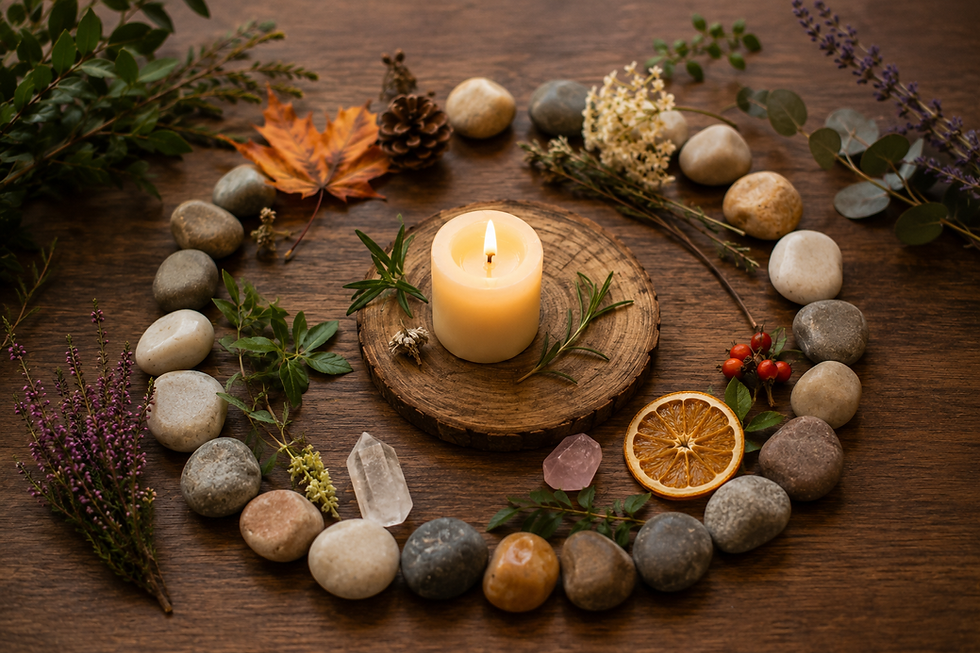
Create a Simple Seasonal Altar
You don't need a stone circle or an ancient grimoire. A small corner of a table is more than enough.
Here's what I personally like to include throughout the year:
Two or three natural objects that represent the current season, such as flowers, leaves, branches, pinecones, or fruit.
A candle whose color reflects the energy of the Sabbat.
A crystal associated with the season—for example, rose quartz in spring, citrine in summer, red jasper in autumn, or obsidian in winter.
A few quiet moments to observe what nature is actually doing outside, rather than relying only on the calendar.
Remember, you don't have to celebrate all eight Sabbats. Start with the one that resonates with you the most this year, and let your practice evolve naturally over time.
Celebrating the Wheel of the Year in the Southern Hemisphere
One important detail that many articles overlook is that the Wheel of the Year is reversed in the Southern Hemisphere. If you live in Australia, New Zealand, South Africa, parts of South America, or anywhere south of the equator, you'll celebrate the opposite seasonal festivals. For example, while the Northern Hemisphere celebrates Yule in December, the Southern Hemisphere experiences Litha, the Summer Solstice.
The golden rule is simple:
Follow the season you're actually living—not the date on the calendar.
The Wheel of the Year is about honoring nature's cycles where you are, not following fixed dates
The Wheel of the Year and the Akashic Records: A Calendar for the Soul
Here's a perspective I rarely see discussed, yet it has profoundly changed the way I experience each Sabbat. To me, the Wheel of the Year isn't only a calendar of nature—it's also a calendar of the soul. Within the Akashic Records, every stage of our spiritual journey follows its own cyclical rhythm. There are seasons of symbolic death and release, much like Samhain. Times of quiet inner growth, like Imbolc. Periods of expansion, creativity, and passion, like Beltane. And seasons of harvest, gratitude, and integration, reflected in Lammas and Mabon.
Learning to recognize where you are within your own inner cycle—regardless of the season outside—is one of the most powerful lessons I share in my Akashic work.
When I perform an Akashic Records reading for someone going through a difficult chapter of life, I often notice that they're experiencing what I think of as an inner Samhain: the necessary ending of one cycle before a new one can begin.
Seeing it this way changes everything. Instead of feeling trapped, we begin to understand that we're simply moving through one phase of a much larger journey. Each Sabbat can also become a powerful gateway for intuitive guidance and channeling.
The energy of every seasonal festival naturally invites different questions:
Samhain: What am I ready to release?
Imbolc: What new seeds are quietly growing within me?
Beltane: What part of my life is ready to fully blossom?
Litha: What deserves to be celebrated?
Lammas: What have I already harvested from my efforts?
Mabon: What wisdom can I carry into the darker season?
Yule: What new light is beginning to emerge?
Ostara: Where am I ready to create greater balance?
In The Powers of the Earth, I explore these seasonal cycles more deeply and show how they mirror the evolution of our own souls.
Final Thoughts on the Wheel of the Year
The Wheel of the Year isn't a rigid spiritual system that has to be followed perfectly. It's an invitation to slow down. To notice the changing seasons. To reconnect with an older, wiser rhythm than the constant pace of modern life. You don't have to celebrate all eight Sabbats right away. Simply begin with the next one on the calendar. Observe what it awakens within you. Allow your practice to grow naturally, just as every living thing does. And if you feel that certain transitions in your life seem to echo these seasonal cycles, an Akashic Records reading may help you understand where you truly are on your soul's journey.

Continue Your Spiritual Journey
Frequently Asked Questions About the Wheel of the Year
What is a Sabbat?
A Sabbat is a seasonal festival that marks an important stage in the annual cycle of nature and the Sun. Together, the eight Sabbats form the Wheel of the Year, with four major Sabbats of Celtic origin (Samhain, Imbolc, Beltane, and Lammas) and four minor Sabbats linked to the solstices and equinoxes (Yule, Ostara, Litha, and Mabon).
Each Sabbat carries its own symbolism and energy, inviting us to honor a different phase of the natural cycle.
What's the difference between the major and minor Sabbats?
The major Sabbats—Samhain, Imbolc, Beltane, and Lammas—come from ancient Celtic traditions and mark key stages of the agricultural year.
The minor Sabbats—Yule, Ostara, Litha, and Mabon—are based on astronomical events: the Winter and Summer Solstices, and the Spring and Autumn Equinoxes.
Together, they create a complete seasonal cycle, with each Sabbat occurring approximately every six to seven weeks.
Can I celebrate the Wheel of the Year without being Wiccan?
Absolutely. The Wheel of the Year can be celebrated from a completely secular perspective as a way of honoring the changing seasons and becoming more mindful of nature's rhythms.
You don't need to follow a particular spiritual path. Simply observing the seasons, creating a small seasonal altar, or keeping a nature journal can already become meaningful practices.
How do I celebrate the Wheel of the Year if I live in the Southern Hemisphere?
In the Southern Hemisphere, the Wheel of the Year is reversed to match the actual seasons.
For example, when the Northern Hemisphere celebrates Yule in December, the Southern Hemisphere celebrates Litha. The most important principle is to honor the season you're actually experiencing rather than following traditional Northern Hemisphere dates.
How are the Wheel of the Year and the Akashic Records connected?
I see the Wheel of the Year as a symbolic map of the soul. Each Sabbat reflects an inner stage of spiritual growth—from release and transformation at Samhain, to renewal at Imbolc, expansion at Beltane, and gratitude at Lammas and Mabon. The Akashic Records often reveal these same cycles unfolding within our lives. An Akashic Records reading can help you identify where you currently are within your own inner season, regardless of the time of year.

Meli Guidance is a certified advanced Akashic records practitioner, a past-life psychic and a channelling coach. She is also trained in oracle cards and tarot readings. Her specialty is helping people grow by reconnecting them with their soul’s purpose and life missions. She believes that by remembering our past lives and seeing what our life plan is for our current incarnation, we can achieve our future self’s highest potential. In addition to channelling spirit guides for people from all over the world in English and French, she offers online courses and coaching sessions to anyone who wishes to develop their ability to communicate with the invisible world.
Instagram @meliguidance
YouTube @meliguidance
Last Update: June 30th 2026


